Best Area to Stay in Charleston SC depends on whether your group values walkability, beach access, parking, nightlife, family space, or a quieter neighborhood. Almost every Charleston trip begins with the same stalled group chat. One person wants to walk out the door into the historic district, someone else wants sand within five minutes, and a third is quietly checking whether anywhere has parking. The truth is that Charleston is not one destination but a cluster of very different ones inside a thirty-minute radius, and picking the wrong base is the single most common way visitors end up spending their vacation in a car.
We host in this city, and the question we field more than any other is simply where to stay. This guide answers it honestly: what each area actually feels like at 8 a.m. and 10 p.m., what you will pay, what you will give up, and which kind of traveler each one rewards. By the end you should be able to close the group chat with a decision everyone can live with.
Quick comparison: Charleston areas at a glance
| Area | Best For | Walkability | Drive to Downtown | Relative Price |
|---|---|---|---|---|
| Historic Downtown | First-timers, couples, walkers | Excellent | You are there | Highest |
| French Quarter | Atmosphere, art, romance | Excellent | You are there | Highest |
| Cannonborough–Elliotborough | Food lovers, better value | Very good | 10-min walk | High |
| Mount Pleasant | Families, balance of city and beach | Low | 10–15 min | Moderate |
| Isle of Palms | Beach families, large groups | Moderate | 25–30 min | Moderate–High |
| Folly Beach | Friend groups, surf, nightlife | Excellent (in town) | 20–25 min | Moderate |
| Sullivan's Island | Couples, quiet, restaurants | Moderate | 20–30 min | High |
| West Ashley / James Island | Budget, longer stays, drivers | Low | 10–20 min | Lowest |
Map your Charleston home base
Compare Charleston neighborhoods, beaches, and nearby favorites
Switch between the areas in this guide to see the neighborhoods, restaurants, and things to do around each potential home base. Travel times update from the selected area so you can compare walkable downtown stays with beach and mainland locations.
Explore from your stay
French Quarter
Historic lanes, galleries, Dock Street Theatre, and the City Market
South of Broad
Quiet residential streets between Broad Street and The Battery
Cannonborough–Elliotborough
Independent restaurants, coffee counters, and residential porches
Harleston Village
Residential downtown near Colonial Lake and the medical district
Upper King Street
Charleston's densest dining, nightlife, and shopping corridor
Staying in Historic Downtown Charleston
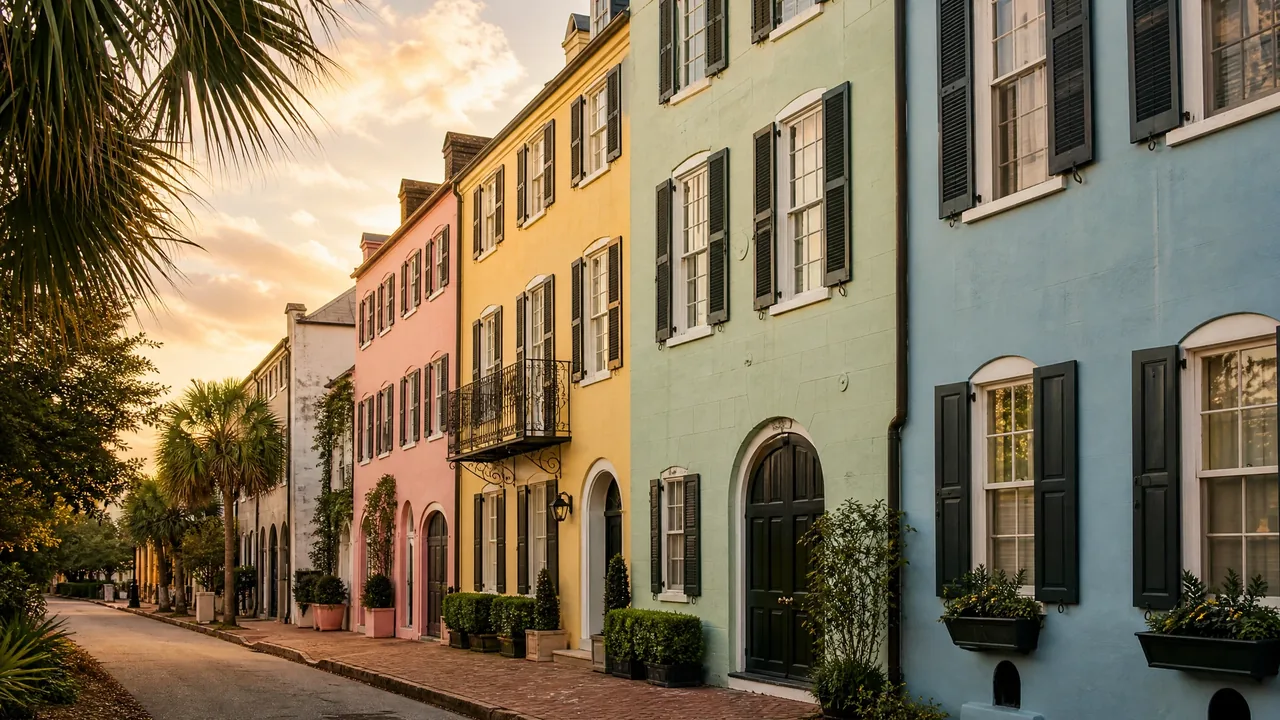
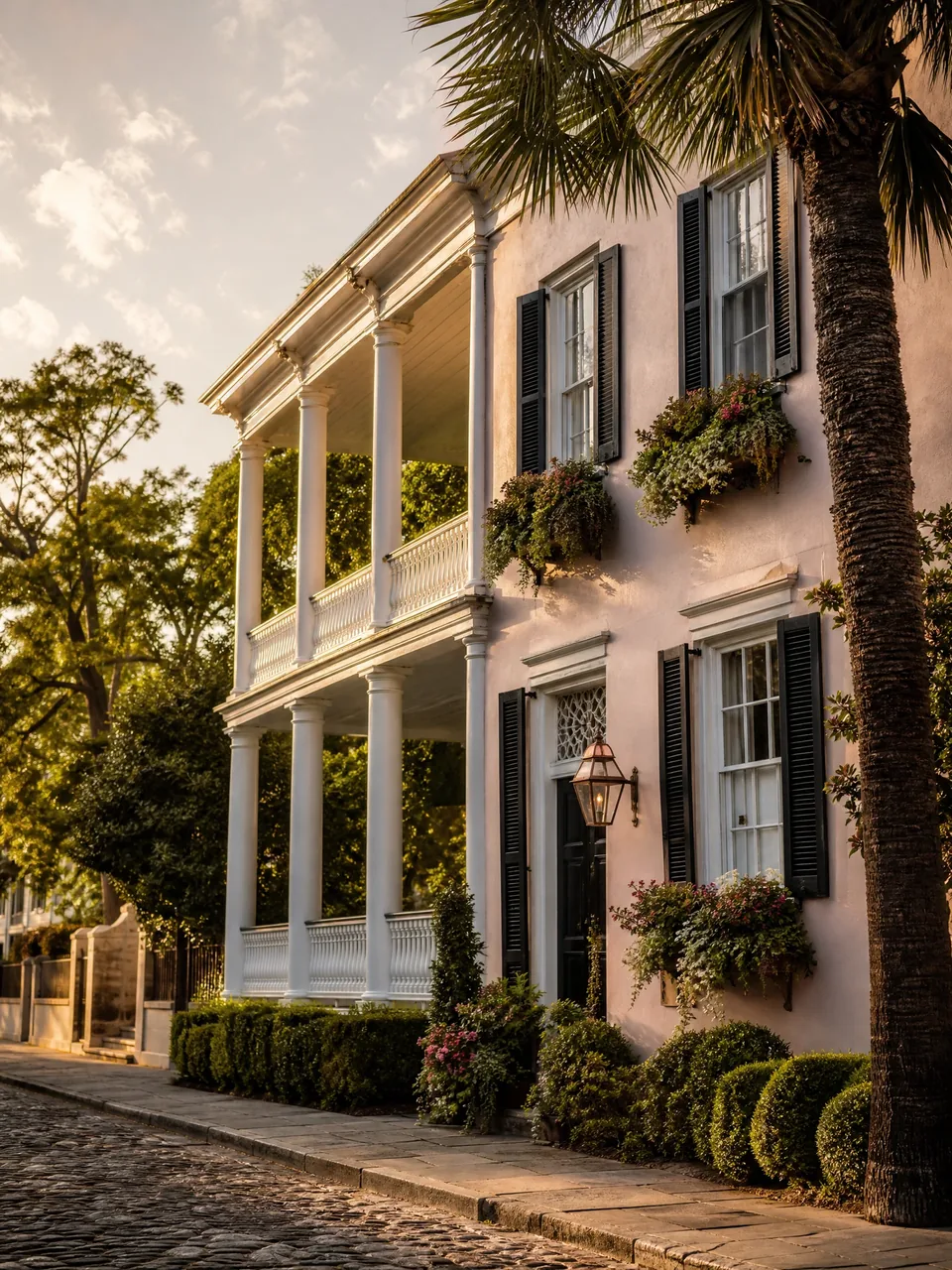
If this is your first visit, or your second, stay downtown. The peninsula below Calhoun Street is where the postcard version of the city actually lives: cobblestones, iron gates, window boxes, the church steeples that earned Charleston its nickname. From a well-placed downtown house you can walk to Rainbow Row, The Battery, the City Market, and roughly forty restaurants without unlocking a car once.
What you trade is money and parking. Downtown carries the highest nightly rates in the region, and off-street parking is a genuine amenity rather than an assumption — always confirm it before booking. Street noise is also real on the busier blocks near Upper King, which is wonderful at 10 p.m. and less wonderful at 2 a.m. Ask where a home sits relative to the bar district if you are a light sleeper.
The French Quarter, for atmosphere above all
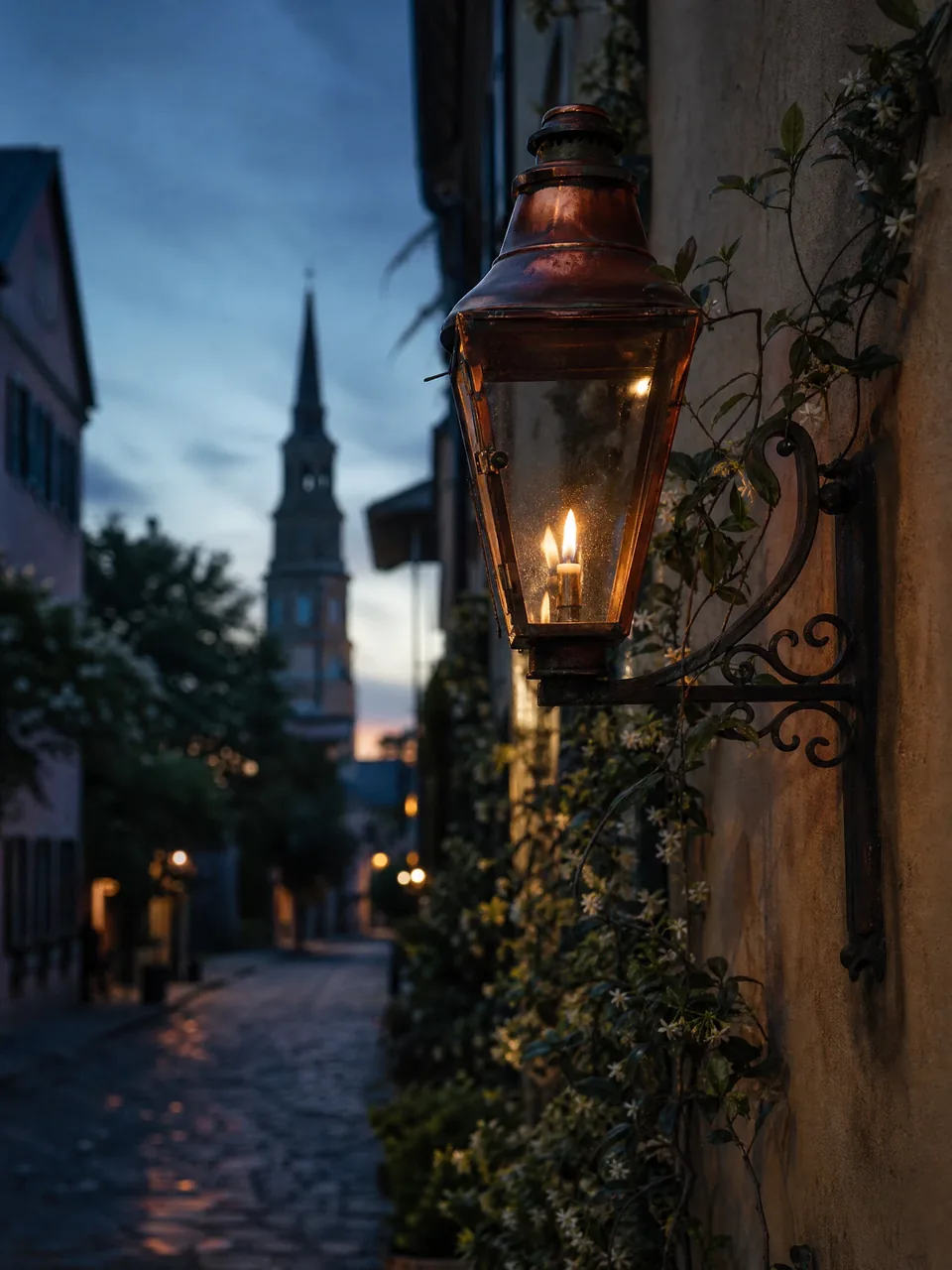
The French Quarter is the most cinematic pocket of downtown: gas lanterns still burning at dusk, art galleries on Broad Street, Dock Street Theatre, and the quiet stretch of Church Street that photographs better than anywhere else in the city. It is a small district, so inventory is limited and it books early. Couples and travelers celebrating something choose it and rarely regret the premium.
Cannonborough–Elliotborough, for food and value
Ten minutes north of the tourist center, Cannonborough–Elliotborough is where a lot of Charleston's best cooking has quietly moved. The blocks around Spring and Cannon streets hold coffee counters, neighborhood restaurants, and porches deep enough to sit out a rainstorm. You give up being directly on the icons and gain a bigger house, a calmer street, and a walk that locals make every day.
Explore downtown by neighborhood:
Staying in Mount Pleasant: the balanced choice
Mount Pleasant sits across the Ravenel Bridge and solves the argument that splits most groups. From here downtown is ten to fifteen minutes one direction and the Isle of Palms beach is ten to fifteen the other. Shem Creek delivers shrimp boats, dock-side restaurants, and dolphins with your dinner; Sullivan's Island is a short hop; and the housing stock skews toward newer homes with driveways, yards, and room for cribs and coolers.
Families and multi-generational trips do best here. You will drive most days, which is the honest tradeoff, but parking is free and easy at both ends, and per-night rates typically undercut comparable downtown square footage by a wide margin.
Choosing a beach: Isle of Palms, Folly, or Sullivan's
Charleston's three main beaches are genuinely different products. Isle of Palms is the widest and most resort-like, with the largest supply of big beachfront houses — the natural pick for families and groups of ten or more. Folly Beach is the loudest and most walkable, a surf town with a real main street where a friend group can eat, drink, and stumble home without a driver. Sullivan's Island is the quietest and most residential, with excellent restaurants, no boardwalk energy at all, and the smallest rental inventory of the three.
- Traveling with kids and grandparents? Isle of Palms, for space and calm water.
- Bachelorette or friends' weekend? Folly Beach, for walkability and nightlife.
- Anniversary or quiet reset? Sullivan's Island, for stillness and good dinners.
- Want beach mornings and city nights? Mount Pleasant, splitting the difference.
Compare the beaches directly:
Where to stay for less: West Ashley and James Island
If the budget is the deciding factor and nobody minds driving, the mainland neighborhoods west of the peninsula are the value play. James Island puts you roughly fifteen minutes from both downtown and Folly Beach — a genuinely useful position — while West Ashley offers the lowest rates in the region along with grocery stores, breweries, and the Ashley River plantations on your doorstep. Neither is walkable to attractions, so plan on a car.
Mainland and value areas:
The downtown neighborhoods most visitors never hear about
Search results collapse the entire peninsula into the phrase downtown Charleston, which hides the fact that the historic district is a stack of small, distinct neighborhoods with genuinely different personalities. Two houses fifteen minutes apart on foot can produce very different trips. Here is how the residential pockets actually differ once you are living in them for a few days.
South of Broad
The oldest and quietest residential quarter, running from Broad Street to the harbor. This is the Charleston of hidden gardens, joggling boards, and houses that turn their broad side to the street to catch the harbor breeze. Evenings here are close to silent, The Battery is a five-minute walk, and the only real noise is carriage traffic during the day. It is also the priciest square footage in the city and the furthest from the restaurant density on Upper King — a fifteen-minute walk north, which is pleasant unless it is August or raining.
The French Quarter
Tiny, atmospheric, and the most photographed few blocks in South Carolina. Gas lanterns still burn on Church and State streets, the art galleries on Broad open on Friday evenings, and Dock Street Theatre puts a working performance venue at the end of your street. Because the district is so small, inventory is thin and turns over slowly. Couples pay the premium here and rarely complain; families sometimes find the houses narrow and stair-heavy.
Ansonborough
The underrated middle ground. Ansonborough sits east of Meeting Street between Calhoun and the market district, which means you are a five-minute walk from the City Market and a ten-minute walk from Upper King's restaurants, but on quiet residential blocks with real trees. Houses tend to be larger than the French Quarter's and cheaper than South of Broad's. If someone asked us for the best all-around downtown compromise, this would be the answer.
Harleston Village
West of King Street around Colonial Lake and the College of Charleston, Harleston Village trades tourist proximity for calm and greenery. Colonial Lake's walking loop is a genuine amenity if you run in the morning, and the neighborhood puts you a flat ten-minute walk from both the market and Upper King. The College means slightly more student energy on weekend nights in the blocks nearest campus — worth asking about if you are a light sleeper.
Cannonborough–Elliotborough and Radcliffeborough
The upper peninsula's café and restaurant district, roughly Spring Street to Cannon Street and up to Radcliffe. Porches get deeper here, houses get wider, rates come down noticeably, and the walk to the historic icons stretches to fifteen or twenty minutes. In exchange you can eat breakfast, coffee, lunch, and dinner within four blocks of your front door, which is why so many locals live here. Radcliffeborough, just north, is quieter still and edges toward the medical district.
Wagener Terrace and Hampton Park Terrace
The far upper peninsula, wrapped around Hampton Park. These are residential neighborhoods with yards, driveways, and almost no tourists — the best value on the peninsula and the only downtown zone where parking is genuinely easy. You are a fifteen-minute drive or a long bike ride from the historic district, so it suits longer stays, families who want space without leaving the peninsula, and anyone planning to cook most nights.
Explore individual downtown neighborhoods:
The outlying areas worth considering
Daniel Island
A planned island community northeast of the peninsula with wide sidewalks, a walkable town center, and the tennis stadium that hosts the Charleston Open each spring. It is about twenty minutes from downtown and thirty from the beaches, with newer construction and easy parking throughout. Families who prioritize modern, low-maintenance houses over historic character often prefer it, and it is the natural base for anyone attending an event at the stadium.
North Charleston
The practical choice for early flights, business travel, and the lowest rates in the metro area. Park Circle has become a genuine dining and brewery neighborhood in its own right, the airport is minutes away, and the Coliseum hosts concerts and hockey. You will drive fifteen to twenty-five minutes to reach the historic district depending on traffic, so this is a base for people who value cost and convenience over walkability.
Kiawah and Seabrook
Roughly forty-five minutes south of downtown, these gated barrier islands are a different vacation entirely: championship golf, ten miles of quiet beach, bike paths through maritime forest, and almost no commercial development. Nobody chooses Kiawah as a base for exploring historic Charleston — the drive makes that impractical — but for a golf trip or a genuinely restorative week, it is the most peaceful option in the region.
Outlying and specialty areas:
Matching the area to your trip
First-time visitors
Stay downtown, ideally below Calhoun Street. You came for the historic city, and being able to walk into it at golden hour without moving a car is the entire point. Three nights downtown teaches you more about Charleston than a week spent commuting into it.
Families with young children
Mount Pleasant or Isle of Palms. Both give you parking, laundry, kitchens, and space to spread out, plus the option of a beach morning followed by an early dinner without a bridge crossing at bedtime.
Couples and anniversary trips
The French Quarter for atmosphere, or Sullivan's Island if the goal is quiet. Both put you near very good dinners and neither requires managing logistics, which is usually what couples are trying to escape.
Large groups and celebrations
Isle of Palms for square footage and beachfront porches, or a downtown whole-house rental if the itinerary is restaurants and bars rather than sand. Groups above twelve should start their search early — the homes that sleep everyone under one roof are the first to go in every season.
Browse by trip type:
Practical notes before you book
Three details decide more Charleston stays than the neighborhood name. First, parking: downtown, off-street parking is a real amenity and should be confirmed in writing. Second, distance measured in minutes rather than miles — the peninsula's one-way streets and the bridges make map distances misleading. Third, licensing: Charleston regulates short-term rentals closely, so book with a permitted operator to avoid a cancellation you did not see coming.
Parking in Charleston, area by area
Parking is the single most underestimated variable in choosing where to stay in Charleston, and it is the detail guests are most likely to discover too late. The historic district was laid out for horses, not SUVs, and the rules vary block by block. Here is what to expect in each area and what to ask before you book.
Downtown: assume nothing
On the peninsula, off-street parking is a genuine amenity rather than a given, and it should appear in writing in your booking. Many historic houses have no driveway at all because there was never room for one. Where a house does include parking, ask how many vehicles fit — a single tandem spot behind a gate is common, and it means a group arriving in three cars has a problem. Residential blocks are largely permit-restricted during the day, and enforcement is real rather than theoretical.
If your house has no parking, the city garages are the answer: there are municipal garages near the market, along King Street, and by the aquarium, and most offer daily and weekly rates that are far cheaper than accumulating tickets. Plan on a five-to-ten-minute walk from garage to front door and factor that into how much you will actually use the car. The practical takeaway is that a downtown stay works best when you use the car twice — arriving and leaving — and walk everything in between.
Mount Pleasant and the mainland: the easy answer
Mount Pleasant, West Ashley, James Island, Johns Island, Daniel Island, and North Charleston all offer free, uncomplicated, off-street parking as standard. Driveways fit multiple vehicles, grocery runs are trivial, and nobody is reading a sign to interpret residential permit hours. For groups arriving in several cars, or families with a minivan full of beach equipment, this convenience is worth more than most visitors expect when comparing nightly rates.
The beaches: permits, lots, and fill times
Beach parking is where day-trippers lose their mornings and where staying on the island pays for itself. Folly Beach has a county park lot at the west end plus limited metered and residential parking near Center Street, and in summer the lot fills by late morning while the residential streets are heavily posted. Isle of Palms uses a mix of paid lots near the front beach and permit-restricted residential zones, with the Connector backing up on summer Saturday mornings and again at beach-exit time in the late afternoon. Sullivan's Island deliberately restricts street parking to preserve its residential character, making it the hardest of the three for a casual day visit.
If sand is central to your trip, the strongest practical argument for a beach rental is simply that it eliminates this entire problem: you walk over the dune from your own house at whatever hour suits you. Ask any beach rental two questions before booking — how many cars the driveway holds, and how many minutes it is to the nearest public beach access.
- Confirm off-street parking in writing, and ask how many vehicles fit
- Ask whether the spot is tandem, gated, or shared with another unit
- If parking is not included, price the nearest city garage by the week
- Beach stays: ask the walking distance to legal beach access
- Arriving in multiple cars? Favor Mount Pleasant or the mainland
Charleston by season: what changes where you stay
Charleston is not one destination across the year, and the right area shifts with the calendar. The same downtown house that feels perfect in April can feel like a poor use of money in July, when everyone in your group wants a pool. Here is how each season changes the decision.
Spring (March to May): downtown's best moment
Spring is peak Charleston and the strongest argument for staying on the peninsula. The azaleas and wisteria peak in late March, the Festival of Houses and Gardens opens private homes through March and April, and Spoleto Festival USA arrives in late May. Porch weather runs all day and the humidity has not yet turned. It is also the most expensive and most competitive season, driven as much by weddings as by tourism — Saturday nights downtown book out first and cost the most.
Practical guidance for spring: book eight to ten weeks ahead, prioritize downtown or a downtown-adjacent neighborhood, and if your dates are flexible, choose Sunday through Thursday. Beach stays in spring are pleasant but the water is still cold through most of May, so the beaches are for walking rather than swimming.
Summer (June to August): the case for a pool or the beach
Summer flips the calculation. Highs sit in the low nineties with humidity to match, and afternoon thunderstorms arrive with near-schedule reliability in the late afternoon. A downtown house with no pool and no yard is a hard sell for a family in July, because the middle of the day has nowhere to go. Isle of Palms, Folly Beach, and Mount Pleasant all become the smarter base, and a private pool moves from luxury to the amenity that determines whether the trip works.
If you do stay downtown in summer, structure days the way locals do: walk the historic district before eleven, retreat indoors or to water from noon to four, and come back out in the evening once the storm has rinsed the heat away. Book four to six weeks ahead for most of the summer, and far earlier for the week of the Fourth of July, which is the single tightest window of the year for beach houses.
Fall (September to November): the local favorite
October is the answer most residents give when asked the best month to visit. Ocean temperatures hold near swimmable into early October, the humidity finally breaks, crowds thin from their summer peak, and the light along The Battery is at its best. Nearly every area works in fall, which makes it the most forgiving season for a booking decision — beach stays still deliver warm water in early fall, and downtown is comfortable all day.
Two caveats. September carries the highest statistical hurricane risk of the year, so travel insurance is worth the small cost for early-fall trips. And October is a heavy wedding month, which tightens downtown Saturday availability and restaurant reservations just as much as spring does.
Winter (December to February): value and oysters
Winter is the insider's season and the best value on the calendar, with rates often well below spring peaks. Highs sit around sixty, which is jacket weather rather than cold, and the city belongs to the people who live in it. This is peak oyster season, restaurant reservations that require weeks of planning in April become walk-ins, and the holiday lights downtown in December are genuinely lovely.
Winter is the season to stay downtown, without much debate. Beach houses are cheap but the beach itself is a walking destination rather than a swimming one, and a pool is useless. Put the savings into a better-located historic house and spend the week walking, eating, and touring the homes you would have queued for in April.
| Season | Best area | Booking lead time | Rate level |
|---|---|---|---|
| Spring (Mar–May) | Downtown / French Quarter | 8–10 weeks | Highest |
| Summer (Jun–Aug) | Isle of Palms, Folly, Mount Pleasant | 4–6 weeks (12+ for July 4) | High |
| Fall (Sep–Nov) | Anywhere; downtown or beach both work | 6–8 weeks | Moderate–High |
| Winter (Dec–Feb) | Downtown | 1–3 weeks | Lowest |
The best area to stay in Charleston is the one that matches how you want to spend your evenings — everything else is a fifteen-minute drive.
Where we would put you
If you gave us your trip and no other information, we would put a first-timer downtown, a family in Mount Pleasant, a friend group on Folly, a couple in the French Quarter, and a reunion of twelve on Isle of Palms. Those five answers cover the vast majority of Charleston trips, and each one puts your evenings where you actually want them.
Frequently asked questions
Planning a trip? Explore our Charleston vacation rentals, browse the local guide, or read our story.